As an Amazon Associate, I earn commission from qualifying purchases.
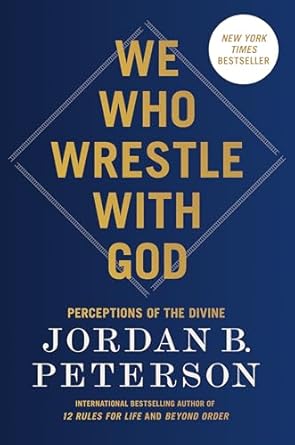
Genesis 32 relates the story of Jacob wrestling with God. This story is hard to comprehend. How can man wrestle with God and not be crushed into nothing, let alone prevail? What does this mean for us today? These are the questions that Jordan Peterson seeks to answer in his book We Who Wrestle With God.
About the Author
Jordan Peterson is a speaker, author, and podcaster with a background in clinical psychology. He has authored a few other books: 12 Rules For Life, Beyond Order, and Maps of Meaning. You can learn more about him on his website jordanbpeterson.com.
Summary
In We Who Wrestle With God, Jordan Peterson examines characters from the Biblical narrative. Specifically looking at how they wrestle with God, whether physically like Jacob, or with words like Abraham or Moses. He examines how they respond to God’s call in their life. He takes these examples and then applies their successes and failures to lessons we can use today.
Analysis
It is not an easy book to read. The wording is very philosophical in nature. The thought processes are long and drawn out. These aren’t bad things; they just make the book less approachable. If you plan to read this one, be sure to have a dictionary ready. I had to look up quite a few words.1
When reading Jordan Peterson, think of it like panning for gold. You’re going to get a decent amount of rock, but you may also get some gold that will make it worth your while. I believe that this book falls into the category of worth my while. I didn’t finish the book thinking I’d wasted 17 hours–that’s how long it took me to read it. Numerous sections provoked extended periods of contemplation. For example, he says, “If you pray (think) toward improper ends, then you will be answered by demonic voices.” He goes on to talk about how people will “judge the credibility of a claim by how quickly and easily it sprang to mind.”2 This brought to mind James 4, where James is describing why people do not receive what they ask for. He says, “You do not have, because you do not ask. You ask and do not receive, because you ask wrongly, to spend it on your passions.” (Ephesians 4:2-3 ESV) Other passages sprang to mind as well (the irony is not lost on me). “The heart is deceitful above all things, and desperately sick; who can understand it?” (Jeremiah 17:9 ESV) Putting these passages together, I can understand how what Peterson is saying lines up with what Scripture teaches. Our thoughts are not innocent and may be influenced by either our wicked hearts or demonic influences. The conclusion is then to critically evaluate what pops into mind. “Beloved, do not believe every spirit, but test the spirits to see whether they are from God, for many false prophets have gone out into the world.” (1 John 4:1 ESV)
One of the common proclivities of human nature is to place higher emphasis on fringe ideas. Jordan Peterson talks about this a bit in his book, but he also falls prey to it. For example, several of the points he was making were drawn from Bible commentaries from fairly random people. For example, on his discussion of Cain, he quoted a commentary on Genesis 4:7: “If you do well, will you not be accepted? And if you do not do well, sin is crouching at the door. Its desire is contrary to you, but you must rule over it.” (ESV) The commentary was stating that the way to interpret this is that sin is like a wild beast ready and waiting to have its way with Cain (in a sexual sense).3
Something to keep in mind while reading is that Jordan Peterson is not a believer. This lends itself to coming to unbiblical conclusions. Some of the conclusions that Peterson comes to in this book are referenced throughout, with other conclusions built off of them. Essentially, snowballing the error. For example, he does not appear to believe the flood actually happened. I don’t believe he says as much in the book, however, he frequently references that the Canaanites are descendants of Cain. Granted, he could mean spiritual descendants rather than physical descendants. This is a relatively minor example, but it exemplifies the caution nonetheless.
One of the things I found thought provoking is Peterson’s use of archetypes. He is essentially from the same school of thought as Carl Jung (he quotes Jung extensively in this work). They have been helpful in that they help us examine each individual and their place in the broader story of Scripture. However, he doesn’t show how these archetypes are often completed in the person of Jesus Christ. For example, Hebrews 3 talks about how Jesus was greater than Moses.
The conclusion chapter of his book was done really well. He succinctly summarizes his entire work in a handful of pages. It was a good way to recap what I had been reading and seeing how it all fit.
I came away from this book with many thoughts to ponder. Even the parts I didn’t agree with him, it gave me practice for thinking through why. It’s not a “must-read,” but it is a good book. It was a great exercise in wrestling through challenging concepts.
- Bookly is a reading app I use, and it has a word tracking feature. You enter the word in and it will supply a definition. You can also save it on a list to reference later. Also, reading on Kindle you can use the x-ray feature to look up definitions just by highlighting the word. ↩︎
- Peterson, Jordan B. 2024. We Who Wrestle with God: Perceptions of the Divine. Portfolio. Page 81. ↩︎
- Peterson, Jordan B. 2024. We Who Wrestle with God: Perceptions of the Divine. Portfolio. Pages 118-119. ↩︎
 Adventure In The Word
Leave a comment