
As an Amazon Associate, I earn commission from qualifying purchases.
Hurry is not of the devil; Hurry IS the Devil.
Carl Jung
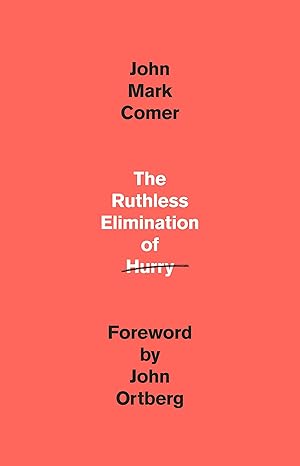
Hurry means being so busy, you miss out on the important things in life. It’s often thought that if you aren’t busy, you are lazy. But is that what the Bible really teaches? That’s what John Mark Comer attempts to work through in his book, The Ruthless Elimination of Hurry. I thought about writing a TL;DR, but I decided that it would have defeated the purpose of reading this book.
About the Author
John Mark Comer is a pastor and author. He has also founded an organization called Practicing the Way that teaches people how to practically live out what Christ teaches. He currently pastors a church in San Francisco, California.
Summary
The main principle of the book comes from Matthew 11:28-30. “Come to me, all who labor and are heavy laden, and I will give you rest. Take my yoke upon you, and learn from me, for I am gentle and lowly in heart, and you will find rest for your souls. For my yoke is easy, and my burden is light.” (ESV) He specifically highlights the portions “I will give you rest” and “My yoke is easy.” He starts by describing that he hit a wall, so to speak, in his life and realized that his life didn’t line up with what this passage was describing. This got him started on finding a solution.
In the first few chapters, he outlines what the problem is and why it matters. He walks through how hurry is the biggest enemy of the spiritual life. We’re too busy with the things of life to spend time focusing on following after God. He talks about how the problem is only getting worse as the internet expands. With how quickly we can access information, our attention span is shortening. All of this puts us in a similar position that he found himself in. Busy with a longing for more time with Jesus.
The solution, he says, is not more time. It’s to slow down. He observes that we spend an immense amount of the time we do have on ultimately meaningless pursuits. Or at a minimum, pursuits that don’t lead us towards God, or fulfilling His commandments. We need to make good use of the time that God has given us. This is where he expounds more on the idea of the “easy yoke” from Matthew 11:28-30. It requires work, yet it is easy. He also points out that this is not a one-time solution, but a way of life.
Lastly, he walks through four spiritual disciplines to help people in their journey of eliminating hurry. They are, silence and solitude, sabbath, simplicity, and slowing. Silence and solitude essentially have to do with embracing boredom. Taking time to meditate or pray. Sabbath is a day of no work as described in the Bible. Simplicity is living a life without the extra frills that distract us from what really matters. Slowing is living life at a slower pace.
He ends the book with a small section based on 1 Thessalonians 4:10-11. “For that indeed is what you are doing to all the brothers throughout Macedonia. But we urge you, brothers, to do this more and more, and to aspire to live quietly, and to mind your own affairs, and to work with your hands, as we instructed you.” (ESV) He specifically focused on “aspire to live quietly.” Living a life that is free from hurry and busyness, and focusing on following after Christ.
Analysis
Overall, the main focus of the book is spot on. We do live in a very busy, hurried culture. There’s more information accessible in seconds than we can work through in an entire lifetime. It makes it very easy to lose our focus on God. The applications for how to slow down our lives and live more purposefully are helpful. Most of the theological points he makes in the book are well done. However, there are a couple of cautions when reading this book.
Firstly, his view of Christ lacks authority—the “way” of Jesus is something to be practiced. Jesus is not only Savior and teacher, but he is also our Lord. As Christians, living a life following Christ is not something to be opted into, but is commanded. (1 John 2:3-4) Throughout the book, you have to go to the back of the book to see where the verses he is quoting are coming from. This essentially seems to be deemphasizing Scripture and its authority.
Secondly, he allows the culture to shape his view of Christ rather than the other way around. He jokes about it in the book. He says, “I’m fine with democratic socialism (don’t judge me—Portland, remember?).”1 There are several instances where this ideology shows up in his book, specifically when it comes to money. The chapter on Simplicity is full of it.2
With that in mind, I did find the book very helpful. I’ve started being more purposeful about avoiding hurry. One thing I’ve discovered is how much stress is associated with trying to be in a hurry. If you’ve ever felt like life is a treadmill you can’t step off of, this book offers a framework—and a gentle push—to begin living differently.
- Comer, John M. 2019. The Ruthless Elimination of Hurry: How to Stay Emotionally Healthy and Spiritually Alive in the Chaos of the Modern World. WaterBrook. Page 80. ↩︎
- For a better handling of the Bible’s view of “things,” I would recommend Joe Rigney’s book The Things of Earth. ↩︎
 Adventure In The Word
Leave a comment