
As an Amazon Associate, I earn commission from qualifying purchases.
“Love–even for the hurting and broken–becomes a demon the moment that it becomes a god.”
Joe Rigney1
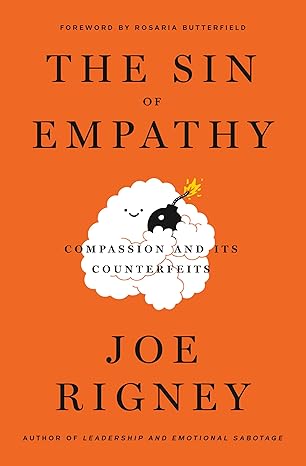
Culture today tells us it is impossible to have too much compassion. It’s either compassion or apathy (lack of care about others). In his book The Sin of Empathy: Compassion and Its Counterfeits, Joe Rigney offers a biblical approach to understanding compassion. He argues that compassion is capable of not only deficiency but also excess. A deficiency of compassion leads to apathy, while an excess—what Rigney calls ‘untethered empathy’—becomes dangerous when disconnected from God’s other attributes, such as truth and justice. Rigney’s argument challenges common assumptions about compassion, and throughout the book, he explores how biblical wisdom provides a more balanced approach.
About the Author
Joe Rigney is a pastor, author, and teacher who has taught college courses on leadership. He is the author of Leadership and Emotional Sabotage, where he explores the challenges of leading with wisdom and resilience. The Sin of Empathy expands on a key section from that book, delving deeper into the dangers of unchecked empathy. Writing from a pastoral perspective, Rigney delivers a message that is both hard-hitting and gracious, guiding readers toward biblical truth. You can learn more about him at nsa.edu/contributors/joe-rigney.
Summary
Joe starts off his book by defining what he means by “the sin of empathy.” Rather than trying to pin down a single definition of empathy, he focuses on how untethered empathy—when separated from the rest of God’s character—becomes dangerous.
Once he has established a definition for moving forward, Joe turns to C. S. Lewis’s The Great Divorce to illustrate his point. He highlights scenes in which characters attempt to garner pity for their suffering, even though they are the cause of it. He identifies this as a form of manipulation, where the “victim” seeks sympathy to shift focus away from their own responsibility. Rather than acknowledging their own actions, they use pity to distract and control those who might otherwise hold them accountable. According to Rigney, this is an example of untethered empathy—when compassion is used to enable irresponsibility rather than lead to truth.
As Rigney explains the manipulation of empathy on an individual level, he then expands the concept to societal implications. Rigney argues that elevating compassion to the status of a god leads not to true mercy, but to cowardice, indifference, and even cruelty. He observes that those who cry out the loudest for compassion are often the least compassionate themselves.
Those who weaponize compassion gain power through what Joe calls “living under the progressive gaze.” This term refers to the societal pressure to conform to increasingly progressive values, often at the expense of biblical truths. People fear being ostracized, so they conform to cultural expectations rather than stand firm in their convictions. One of the biggest tools used to perpetuate this pressure is untethered empathy. Rigney argues that the correct path forward is to reject this pressure, refuse to play the game, and remain unashamed of the Bible and all that it teaches.
He traces the current state of affairs to what he identifies as the “cancer” of feminism. Rigney argues that while God created women to be more empathetic than men, this empathy, in its unchecked form, is not suited to defend biblical doctrine in the church. The solution, he asserts, is to once again stand firm on biblical principles.
Lastly, Joe makes the case for true compassion to avoid falling into the pitfall of apathy. He argues that the correct approach is to be sober-minded in our compassion. He draws from Christ’s examples of compassion and shares how Father Zossima in The Brothers Karamazov provided him with insight into how to truly “weep with those who weep.”
Analysis
He is clear and accessible in his writing, but given how deeply ingrained the sin of empathy is in our collective psyche (I’ve been reading Jordan Peterson—can you tell?), it’s not an easy pill to swallow. It will likely take me a few readings to fully grasp.
However, I believe Rigney effectively dismantles the counterfeits of compassion, showing how they distort our understanding of true empathy. He also provides a well-structured view of what true compassion looks like, focusing on how it is tethered to God’s character, including truth and justice. His use of stories, such as C.S. Lewis’s The Great Divorce and Father Zossima from The Brothers Karamazov, combined with insights from other authors like Edwin Friedman, strengthens his arguments. Additionally, Rigney gives numerous real-world examples to illustrate the consequences of untethered empathy.
While Rigney doesn’t present entirely new ideas, his ability to synthesize and modernize these concepts makes them highly relevant for today’s readers. The Sin of Empathy serves as a prequel to his earlier work Emotional Sabotage, providing a foundational understanding of how compassion, when misunderstood, can lead to personal and societal harm.
Personal Response
My favorite chapter in the book was the one where Rigney praises true compassion. I especially loved the comparison he makes to the verse “Be angry and do not sin.” (ESV Ephesians 4:26) He says you can fill in “pity” into that verse: “In your pity, in your compassion, do not sin.”2 This struck me deeply because it shows that even something as virtuous as compassion can be distorted when not rooted in truth.
Before reading The Sin of Empathy, I had a vague understanding that empathy could be harmful. I had come across the idea in other books, but reading a book dedicated entirely to this concept has been immensely helpful. It’s given me a much clearer picture of how empathy, when untethered from God’s character, can become a tool of manipulation and irresponsibility. I’m sure a second or third reading will only deepen my understanding.
This book will be incredibly helpful for anyone seeking to better understand true, biblical compassion. For newer believers, I would recommend starting with “Chapter 6: In Praise of Compassion.” This chapter offers a solid biblical foundation for understanding compassion, and once that foundation is set, the rest of the book will help clarify the counterfeits and pitfalls to avoid.
In the end, The Sin of Empathy has deepened my understanding of what true biblical compassion is. It’s not about enabling people’s wrong behaviors but walking alongside them while pointing them to truth. I look forward to putting these insights into practice in my roles as father, husband, and Christian.

 Adventure In The Word
Leave a reply to RJ Potter Cancel reply