As an Amazon Associate, I earn commission from qualifying purchases.
Colossians 3:1-4 “If then you have been raised with Christ, seek the things that are above, where Christ is, seated at the right hand of God. Set your minds on things that are above, not on things that are on earth. For you have died, and your life is hidden with Christ in God. When Christ who is your life appears, then you also will appear with him in glory.” (ESV)
Philippians 3:8 “Indeed, I count everything as loss because of the surpassing worth of knowing Christ Jesus my Lord. For his sake I have suffered the loss of all things and count them as rubbish, in order that I may gain Christ.” (ESV)
1 Timothy 4:4-5 “For everything created by God is good, and nothing is to be rejected if it is received with thanksgiving, for it is made holy by the word of God and prayer.” (ESV)
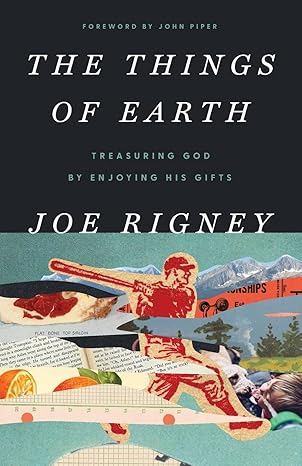
These verses and many others appear to be at odds with each other. On the one hand, you have “set your mind on Christ,” and on the other, we are told to receive God’s good creation with thankfulness. So, what do we do with the things of earth? This is the question that Joe Rigney dives into in his book The Things of Earth.
About the Author
Joe Rigney is a self-proclaimed Christian Hedonist (in addition to being an author, pastor, and teacher). The term was coined by John Piper, with whom Joe Rigney has done a lot of work. The idea, however, goes back even further. Like Solomon said, “nothing new under the sun.” (Ecc. 1:9, ESV) Come to think of it, Solomon may have been an early version of a Christian Hedonist—or just a plain hedonist. The essential idea is, “God is most glorified in you when you are most satisfied in him.” — John Piper
Summary
Rather than diving into the nitty gritty of the Greek and Hebrew behind the selected passages, Joe starts with a study of who God is. Specifically the doctrine of the Trinity. Using Jonathan Edwards as a guide, he outlines how the love that God has for us stems from the love that the Persons of the Trinity have for each other.
He then moves from God’s relationship with the Trinity to His relationship with His creation and ultimately with His pinnacle creation–us. Unfortunately, we as sinful creatures are prone to idolize the gifts of God and in the wickedness of our hearts twist the gifts into evil purposes. On the opposite side, we are also prone to deny the good gifts of God in an effort to avoid falling into the other error. Joe spends several chapters working through all of these ideas.
Ultimately, the answer to the question above is we enjoy the things of earth with thankfulness to God and hold them loosely. By rooting his argument in the eternal joy shared within the Trinity, Rigney shows that our joy in created things is not incidental but reflective of God’s own nature.
Analysis
Joe Rigney has done an excellent job in striking the balance between keeping our focus on Christ and the proper place of “things” in that focus. Like Job, he encourages us to praise God who gives good gifts and takes away good gifts. He reminds us that we can praise God because God does all things for His glory. This book is a step in the direction for any Christian to what Paul outlines in Philippians 4:11-12–being content in all situations.
I’ve found this book to be very helpful in fighting against the guilt and shame that comes from enjoying God’s gifts. This guilt and shame comes from Satan who is trying to convince us that even when we are doing good, we are sinning.
Joe has written a shorter version of this book as well called Strangely Bright. It doesn’t dive as much into the depths of the theological side, but focuses in on enjoying and glorifying God by enjoying His gifts.
This book is for anybody who struggles with low-grade guilt for finding enjoyment in anything but God. God is our Heavenly Father who delights in giving good gifts to His children. As the Westminster Shorter Catechism says, “What is the chief end of man? Man’s chief end is to glorify God, and to enjoy him forever.” (WSC 1, italics mine)
 Adventure In The Word
Leave a comment